
The St. Louis City Inmate Population
The St. Louis City inmate population is centered on the City Justice Center, the local jail at 200 South Tucker Boulevard. The official City Justice Center page says the six-story jail opened in 2002 and has capacity for 860 inmates. The facility is operated by the City of St. Louis Department of Public Safety, Division of Corrections. That matters because St. Louis City does not use the usual Missouri county sheriff model for jail operation. Local jail questions should be routed to the Division of Corrections, not to St. Louis County in Clayton.
The official Corrections Division describes its role as housing people arrested by police and waiting for a chance to answer charges in court. The city also has the Transition Center of St. Louis, but that facility is a Missouri Department of Corrections residential reentry center, not the city jail. It serves men released from adult institutions or under community supervision who need structured transition services.
St. Louis City Inmate Population Statistics
The official St. Louis inmate population dashboard is the strongest source for the St. Louis City inmate population over time. It reports average daily population by year and lets users filter by total population, race, sex, facility, marital status, employment status, top offense class, and age group. The dashboard also warns that one individual may have more than one classification, that the highest classification charged is used, and that people listed as "Out" may still require a reserved bed.
The City Justice Center overview and the population dashboard should be read together. The jail capacity figure comes from the CJC facility page, while the average daily population figures come from the dashboard. The dashboard says data is supplied by the St. Louis City Division of Corrections and may run up to 5% higher because the system counts everyone in CJC, including inmates and detainees.
| Measure | Figure | Source / Year |
|---|---|---|
| Average daily population | 763 | City inmate population dashboard, 2026 table generated June 19, 2026 |
| Rated capacity | 860 | Official City Justice Center page, inspected June 2026 |
| 2025 average daily population | 771 | City inmate population dashboard |
| 2024 average daily population | 728 | City inmate population dashboard |
| Annual bookings | Not located | Official CJC and dashboard sources did not publish that figure |
The City dashboard screenshot in the project image set shows the official population data source used for these figures. The dashboard page is the right place to verify the current table before using any count in court, bond, or reporting work.
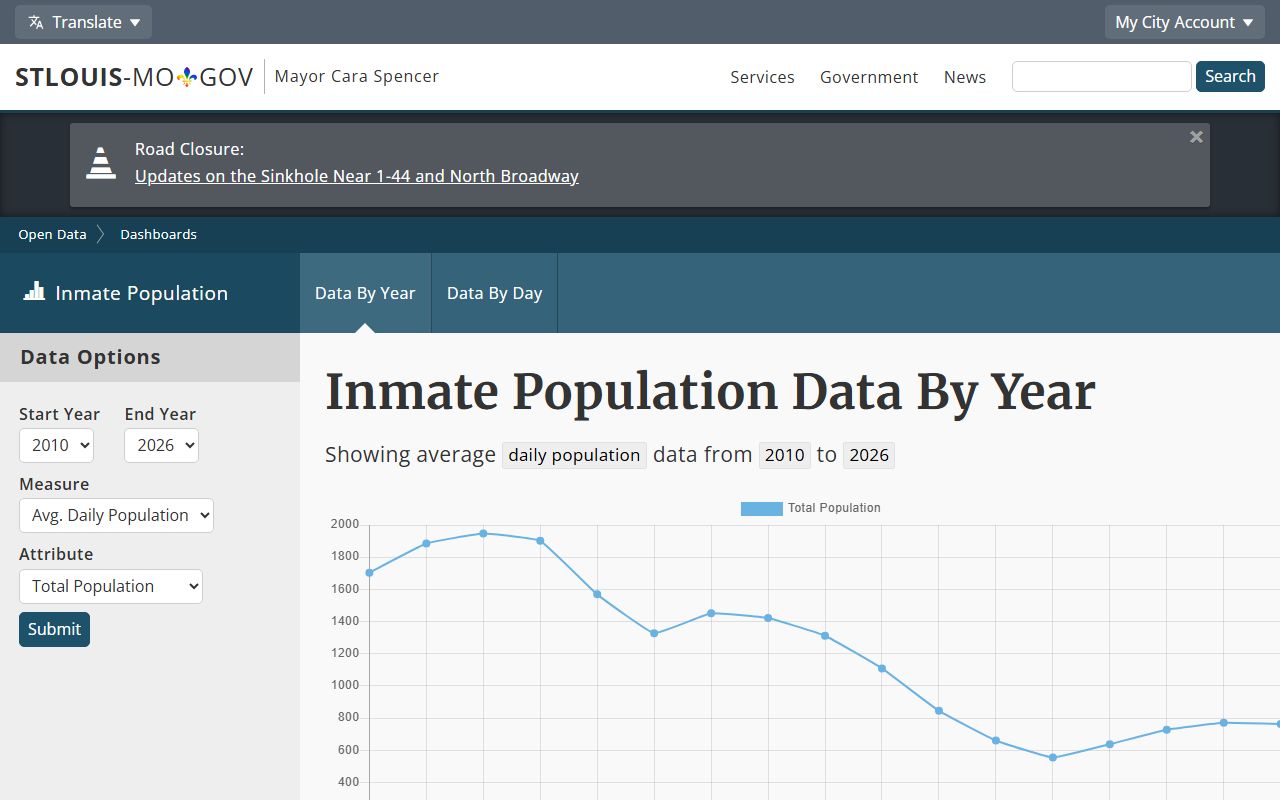
The dashboard is useful because it separates population data from the live jail roster. A person may be counted in the jail population even when a name search fails during police processing, transport, or release.
St. Louis City Inmate Population Trends
The St. Louis City inmate population changed sharply across the dashboard years captured in the research. The average daily population peaked in the captured table at 1,947 in 2012, fell below 1,200 by 2019, dropped to 555 in 2022, and then rose into the 700s by 2024 through 2026. The research file does not assign a single cause to each shift, so the table should be read as official population history, not as proof of one policy outcome.
| Year | Average Daily Population | Note |
|---|---|---|
| 2010 | 1704 | Pre-Workhouse-closure era city corrections count. |
| 2012 | 1947 | Peak in the captured 2010-2026 dashboard table. |
| 2019 | 1109 | Below 1,200 before the later steep decline. |
| 2022 | 555 | Lowest captured year. |
| 2024 | 728 | Increase from 2023. |
| 2025 | 771 | Higher than 2024. |
| 2026 | 763 | Slightly below 2025 in current-year data. |
Using the captured 2026 average daily population of 763 against the official CJC rated capacity of 860 gives about 89% of rated capacity before the dashboard caveat is applied. That is why the population page should not call CJC overcrowded from these figures alone. Separate oversight, litigation, staffing, and conditions issues may exist, but capacity language should stay tied to the cited city data.
Who Makes Up St. Louis City Inmates
The St. Louis City inmate population is mostly a local jail population when the question is current city custody. The City says the Division of Corrections houses citizens arrested by police and awaiting court. The Commissioner page also describes pre-trial and sentenced inmates confined in one local facility, the City Justice Center. That mix is different from a state prison population, where people are held after a felony sentence and are searched through the Missouri Department of Corrections.
- Pre-trial custody covers people arrested and held while charges, bond, or court dates are pending.
- Local sentenced custody covers people serving time locally at CJC rather than in a state prison.
- Police custody may include new arrests still on the first floor, at a substation, or waiting for transport.
- State supervision belongs in MODOC systems after transfer, probation, parole, or reentry placement.
- Federal or immigration custody uses BOP, U.S. Marshals, court, or ICE channels, not the city roster alone.
The dashboard has filters for race, sex, facility, top offense class, and age group, but the research file did not capture specific demographic counts from those filters. For that reason, the page uses the published total and trend figures and does not invent race, sex, age, or charge-level percentages.
Laws Governing St. Louis City Inmates
Missouri public-record rules explain why some St. Louis City inmate population information can be searched online while other material must be requested. Current custody and basic roster data are public-facing through the city locator. Older booking records, booking photographs that are not online, arrest reports, or other non-posted documents usually require a Sunshine Law request through the City Counselor's GOV/QA process.
Key Missouri access rules:
RSMo 610.011 states Missouri's policy that public records of public governmental bodies are open unless a law provides otherwise.
RSMo 610.023 describes inspection and copying duties for public bodies and is the core request-and-copying section.
RSMo 610.100 covers law-enforcement incident, investigation, and arrest records, with arrest reports generally treated as open records.
RSMo 610.140 allows eligible criminal records to be closed by court-ordered expungement.
St. Louis routes city public-record requests through the City Counselor Sunshine request page. The city instructs requesters to check open data first, choose "Begin online," submit a Sunshine Law and Public Records Request, pick the department group, and use an account to track messages, invoices, payments, and released records.
How to Search St. Louis City Inmates
The current St. Louis City inmate search starts with the city's Locate a St. Louis City Inmate page, which links to the official STL Inmate Locator. The city warns that exact first and last name are needed. Similar names are not returned. If a person does not appear, the reason may be police custody, substation custody, release, or a mismatch between the searched name and arrest paperwork.
- Start at the city inmate-locator page, then open the linked STL Inmate Locator.
- Enter the exact last name and exact first name used on the arrest paperwork.
- Complete the reCAPTCHA and run the search.
- Review the result columns for inmate name, year of birth, race, sex, and facility.
- Open a name if a profile link is available, then compare charges with Case.net or Municipal Court.
- If no result appears and custody is still likely, call SLMPD Prisoner Processing at 314-241-8339.
The research screenshot from the STL Inmate Locator shows the exact-name form and disclaimer. That form is useful for current local custody, but it is not a full court-disposition record.
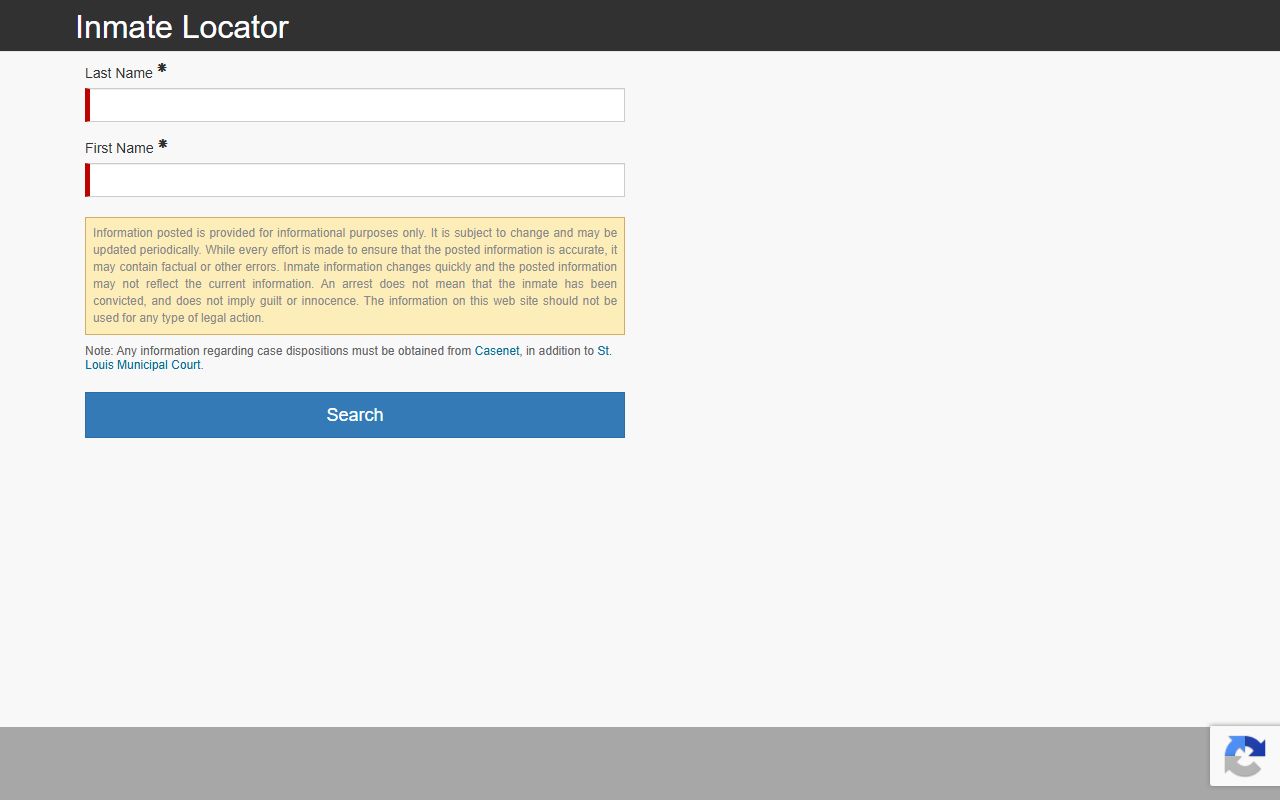
The locator should be paired with court and records channels. The locator itself says disposition information must come from Case.net and St. Louis Municipal Court.
Current Inmate Lookup in St. Louis City
Current lookup in St. Louis City is narrow by design. The visible search fields require first and last name, not a broad browsing filter. The shared locator code includes features used by another county, but the research notes not to claim those as public St. Louis City filters unless they are visible in the browser. For St. Louis City, exact name search is the rule.
| Field Label | Type | Required | Notes |
|---|---|---|---|
| Last Name | Text | Yes | Uppercase text; exact last name required by the city page. |
| First Name | Text | Yes | Uppercase text; exact first name required by the city page. |
| reCAPTCHA | Automated challenge | Yes | Search submits with Google reCAPTCHA validation. |
| Filter results | Result control | No | Appears after results load in the DataTables view. |
Result rows show inmate name, year of birth, race, sex, and facility. A detailed profile may add arrest date and time, release date and time, charges, case number, next court date, and status. Bond amount and bond type columns are hidden for St. Louis City in the captured shared code, so bond questions should use the city bond phone numbers.
Past St. Louis City Inmate Records
Past and released St. Louis City inmate records require a fallback chain. The city locator is built around current custody and quickly changing jail data. The research did not verify a public released-in-the-past-72-hours filter for St. Louis City, even though similar code exists for another county. If the person has left CJC, start with Case.net for court status and then use the City Sunshine process for older booking records, arrest reports, booking photos, or letters of incarceration.
For people transferred to state custody, use the Missouri DOC Offender Web Search. MODOC says the locator searches active offenders, including probationers and parolees, and may include aliases. It does not list discharged offenders, and some people may be excluded for safety, security, or confidentiality reasons. For federal sentenced custody, use the BOP inmate locator. For immigration custody, use the ICE Online Detainee Locator System.
What a St. Louis City Inmate Record Shows
A St. Louis City inmate record is a custody record, not a conviction record. Booking charges can change, be amended, or be dismissed. The profile should be read with the court record, especially when the question is whether a charge led to a conviction, a warrant, a bond change, or a court date.
| Field | What It Shows |
|---|---|
| Inmate Name | Public display name in the result and profile. |
| Year of Birth | Birth year only, not full date of birth in the visible template. |
| Race and Sex | Demographic fields returned by the locator. |
| Facility | CJC or another holding location returned by the system. |
| Arrest Date/Time | Booking or arrest time shown in the detail profile. |
| Release Date/Time | Release time when a release appears in the detail profile. |
| Charges | Charge description, case number, next court date, and status table. |
| Mugshot | Photo area may show a supplied image or "Inmate Photo Not Available." |
St. Louis City Jail vs State Prison
Many failed St. Louis City inmate searches happen because the search starts in the wrong system. CJC is the local jail. It holds people arrested by police, people waiting for court, and some people serving local sentences. MODOC is the state corrections system for sentenced offenders, probationers, parolees, and reentry placements such as the Transition Center of St. Louis.
| City Justice Center | Missouri DOC | Federal / ICE | |
|---|---|---|---|
| Who is covered | Local arrests, pre-trial custody, local sentences | Active state offenders, probationers, parolees, reentry residents | Federal inmates or immigration detainees |
| Operator | City Division of Corrections | Missouri Department of Corrections | BOP, ICE, USMS, or court channels |
| Where to search | STL Inmate Locator | MODOC Offender Web Search | BOP locator or ICE ODLS |
| Common gap | New police custody may not appear yet | Discharged offenders are not listed | No local CJC roster control |
St. Louis City Detention Facilities
The St. Louis City inmate population map has one local jail and one state DOC reentry facility inside the city footprint. The old Workhouse is important local context, but the research did not identify it as a current active roster facility for new city jail searches.
- City Justice Center is the city jail for people arrested by police, people awaiting court, and locally confined sentenced inmates.
- Transition Center of St. Louis is a Missouri DOC residential reentry and community supervision facility for men, not a city jail booking facility.
St. Louis City Inmate Population FAQ
How large is the St. Louis City inmate population? The city dashboard table captured in the research showed a 2026 average daily population of 763. The official City Justice Center page lists capacity at 860 inmates.
Why does a St. Louis City inmate search fail? The city says a person may still be in police custody, at a substation, already released, or listed under a name that does not match the search.
Does St. Louis City have a sheriff jail roster? No. The local jail is operated by the City of St. Louis Department of Public Safety, Division of Corrections.
Where are sentenced state prisoners searched? Use MODOC Offender Web Search for active Missouri offenders, probationers, parolees, and state supervision records.