
St. Louis City Court Records After a Jail Arrest
Court records after a jail arrest in St. Louis City should be read alongside, but separate from, City Justice Center custody information. The City of St. Louis Department of Public Safety Division of Corrections operates the City Justice Center, not a sheriff's jail. Its locator and jail records help confirm custody, booking information, and facility placement. Formal case outcomes are not decided by the jail. The locator research points users to Missouri Case.net and St. Louis Municipal Court for case dispositions.
The court path depends on the charge type. The St. Louis City Municipal Division is part of the 22nd Judicial Circuit, but it handles municipal matters such as traffic citations from SLMPD or the Missouri State Highway Patrol, dumping or prohibited refuse, housing code, minor criminal, earnings tax, and truancy violations. State criminal misdemeanors and felonies belong in Circuit Court for the 22nd Judicial Circuit and are prosecuted by the Office of the Circuit Attorney. Gabriel Gore is listed as the current Circuit Attorney for state-level criminal cases in the City of St. Louis.
Use jail inmate records for the current custody side and jail roster mugshots for booking-photo questions. A court record after an arrest is the charge and case record, not a promise that a mugshot, jail photo, or historical booking image will appear online.
Municipal Court vs. 22nd Judicial Circuit Court Records After Arrest
St. Louis City is an independent city, so readers should not assume that St. Louis County courts or the St. Louis County Justice Center in Clayton control a City arrest. For City arrests, the first split is municipal versus state criminal jurisdiction. Municipal Court covers ordinance and municipal matters. Circuit Court in the 22nd Judicial Circuit covers state criminal misdemeanor and felony cases, along with other court categories that Municipal Court says it does not handle, such as civil cases, divorces, evictions, orders of protection, and jury trials.
That distinction matters because the charge source and the practical follow-up are different. A municipal traffic or ordinance case may be routed through the St. Louis City Municipal Court search instructions and municipal customer service. A felony or state misdemeanor after a City jail arrest should be searched through Case.net under City of St. Louis - 22nd Judicial Circuit, with the Circuit Attorney's Office as the state criminal prosecutor. Municipal recommendations may involve the City Counselor, so do not treat every City court record as a Circuit Attorney filing.
How to Find Court Records After an Arrest in St. Louis City
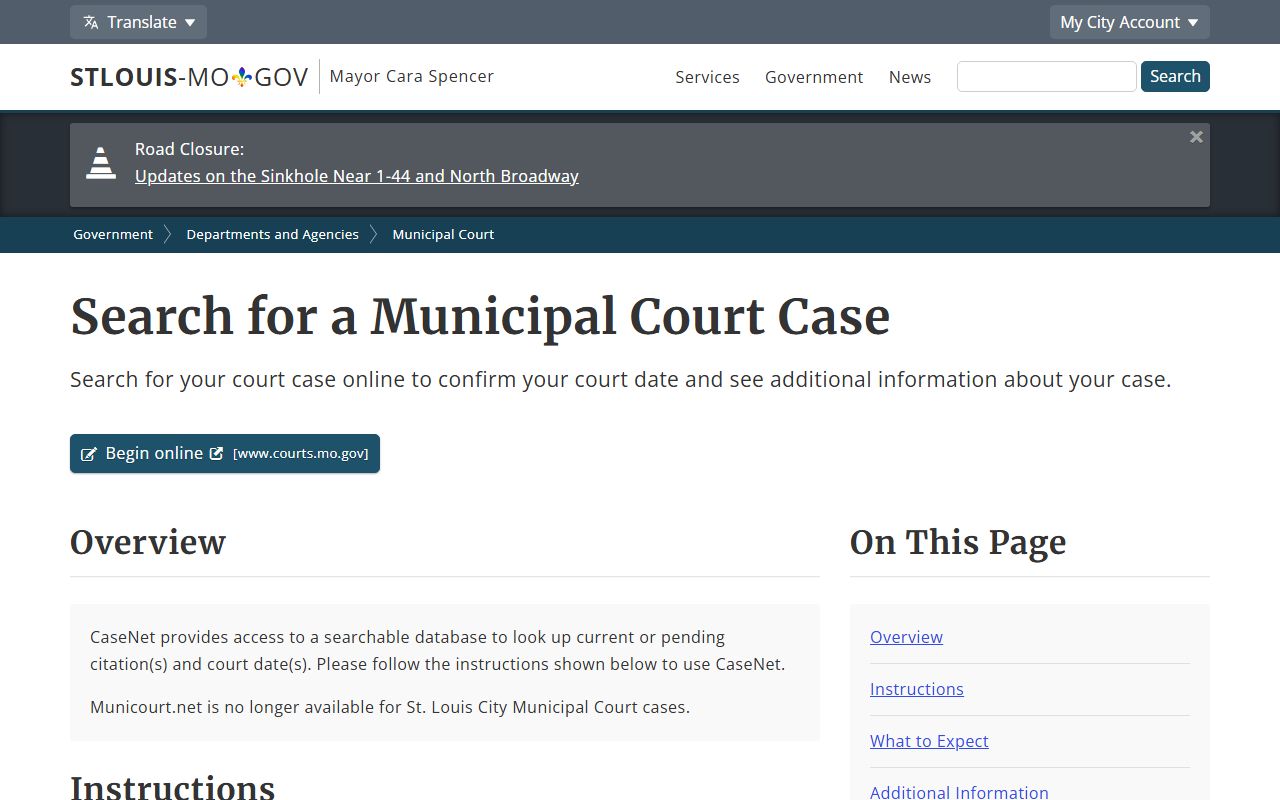
The City's municipal-court search page routes users to Missouri Case.net. It gives a practical path for checking charges after a jail arrest, but the search is still a court lookup, not a jail roster. The City instructions tell users to choose Case Number Search or Litigant Name Search, select City of St. Louis - 22nd Judicial Circuit, enter the case number or name details, and narrow with Location or Case Type when looking for municipal matters.
- Open the St. Louis Municipal Court violation search page and use its Begin Online link to Case.net.
- Choose Case Number Search if a citation, docket, or case number is available. For traffic citations, the number appears at the upper right of the citation.
- Choose Litigant Name Search when starting from a defendant name. Add date of birth in MM/DD/YYYY format when available to reduce false matches.
- Select City of St. Louis - 22nd Judicial Circuit in the search-for-cases field. For municipal matters, use Location and Case Type filters such as St. Louis City Municipal or Traffic/Municipal when available.
- Open the matching result, review the charge list, and check every charge status rather than assuming the first listed charge is the final disposition.
The City notes that a new citation may take a few days to process. If a pre-2024 municipal case cannot be found, the City directs people to the Municipal Court Customer Service window at 1520 Market with picture ID or to call (314) 622-3231. For state criminal matters, Case.net remains the public case-search path, but questions about custody, bond, and release may still require the separate bond phone numbers listed below.
The City publishes its Municipal Court Case.net instructions at stlouis-mo.gov.
The state Case.net portal at courts.mo.gov is the shared Missouri court search system used for City municipal and 22nd Judicial Circuit case lookups.
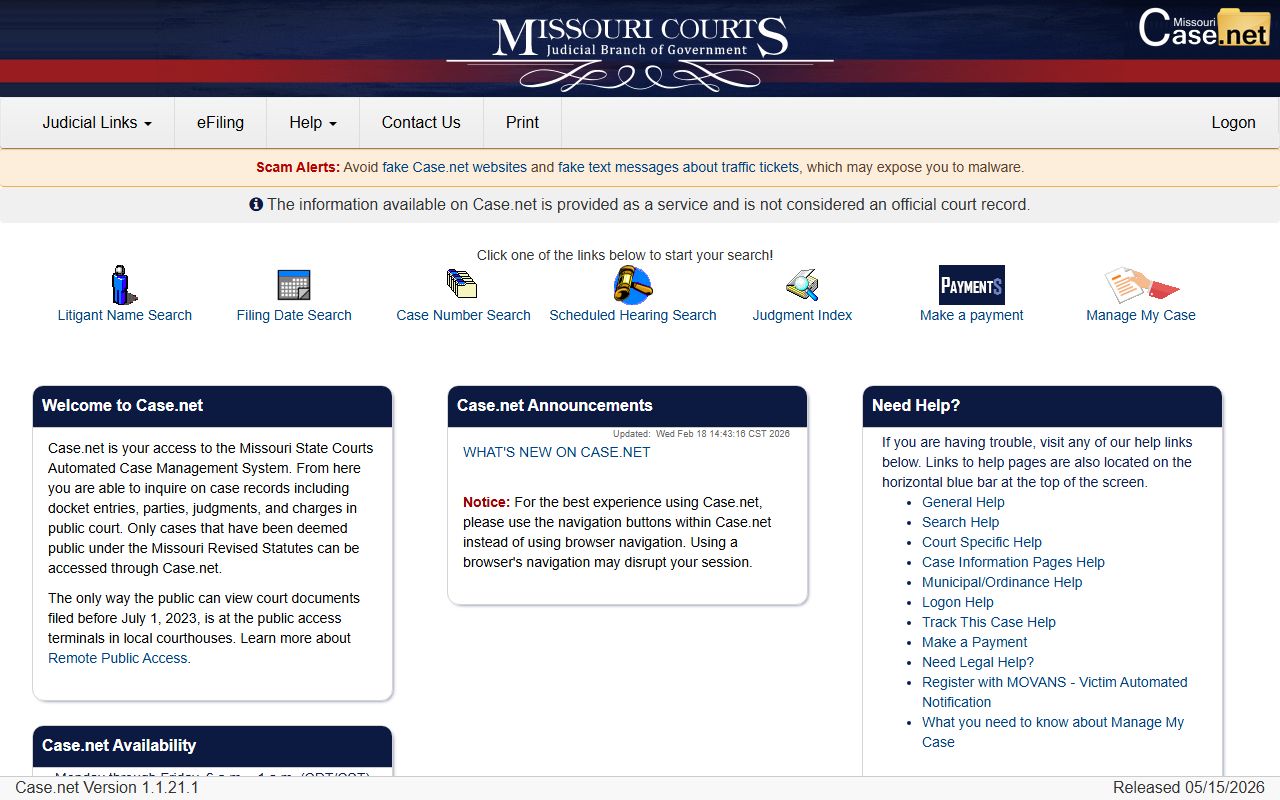
Case.net Search Fields for St. Louis City Court Records
Case.net searches work best when the search field matches the information in hand. A citation number is cleaner than a common name. A name search can still work, but St. Louis City records may include people with similar names, older municipal cases, or cases that have not yet processed into the portal.
| Field Label | Type | Required | Options or Format Notes |
|---|---|---|---|
| Search for cases in | Dropdown | Yes | Select City of St. Louis - 22nd Judicial Circuit for city cases. |
| Case Number | Text | For case-number search | For traffic citations, the number appears at the upper right of the citation. |
| Last Name | Text | For litigant-name search | Use the defendant or litigant last name as filed. |
| First Name | Text | For litigant-name search | Use the defendant or litigant first name, and check spelling variants. |
| Date of Birth | Date | Optional | Use MM/DD/YYYY format when known. |
| Location | Dropdown | Optional | Narrow to St. Louis City Municipal for municipal matters. |
| Case Type | Dropdown | Optional | Narrow to Traffic/Municipal for municipal matters. |
| Buttons | Button | Not applicable | Find starts the search; Get Related Cases may appear in results. |
Charging Documents After an Arrest: Complaint, Information, and Indictment
Booking at the City Justice Center is an intake event. A formal court record begins when the proper charging authority files a document with the court. The document can change the reader's understanding of the arrest because booking labels may be preliminary, shorthand, or based on the arresting agency's first information. The court filing is where the charge is framed for prosecution.
| Complaint | Information | Indictment | |
|---|---|---|---|
| Filed By | Usually an officer or prosecutor, depending on the matter. | Prosecutor, including the Circuit Attorney for state criminal cases. | Grand jury after it returns the charge. |
| Common For | Initial municipal, misdemeanor, or early criminal filings. | Many state criminal prosecutions after review by the prosecutor. | Serious felony matters or cases presented to a grand jury. |
| Starts | The court case or early case record. | The formal prosecution in court. | The formal prosecution based on grand-jury action. |
| Why It Matters | May explain the first accusation after arrest. | Often reflects the prosecutor's reviewed charge decision. | Shows that the charge came through a grand-jury process. |
Charge Status and What It Means in Court Records After Arrest
Charges can move several times after an arrest. A jail locator charge, a first complaint, and the final disposition may not match. Prosecutors may add, reduce, amend, or dismiss counts. A court may also enter a disposition that applies to one charge but not another, so each count should be read separately.
| Status | What It Means |
|---|---|
| Pending | The charge is still active and no final court disposition has been entered for that count. |
| Amended or Reduced | The prosecutor or court record changed the charge, level, wording, or count from an earlier version. |
| Dismissed | The court ended that count without a conviction on that charge, although other counts may remain. |
| Nolle Prosequi | The prosecutor declined to proceed on that charge, often shown as a dismissal by the state. |
| Guilty Plea or Finding | The case resulted in a conviction on that count through plea or court finding. |
| Disposed | The court entered an outcome. Read the docket and charge rows to see what the outcome was. |
Bond Channels After a St. Louis City Jail Arrest
Bond in St. Louis City is highly local because the correct channel depends on charge type and custody stage. The City says the St. Louis Municipal Courts administer bail bonds after an arrest. Before going in person, determine whether the person is held on City municipal charges or state charges. For City charges, call (314) 622-3231. For state charges, call (314) 641-8214. Have the person's first name, last name, and date of birth ready.
Police custody for 24 hours or less is handled on the 1st Floor of City Justice Center, 200 South Tucker Boulevard, through the Bond Commissioner's Office. That window is listed as open 24/7, with phone 314-241-8339, and accepts St. Louis City ordinance warrants and fugitive warrants up to a misdemeanor. For CJC inmates held less than 24 hours, the Carnahan Courthouse Room 108 at 114 Market Street is listed Monday through Friday, 8:30 a.m. to 5 p.m., phone 314-622-3340, while the 2nd Floor CJC window is listed Monday through Friday, 5 p.m. to midnight, and 24/7 on court holidays, Saturdays, and Sundays, phone 314-641-8214.
For CJC inmates incarcerated more than 24 hours, the City lists the Municipal Courthouse, 1520 Market Suite #1120, Saint Louis, MO 63103, Monday through Friday, 8:30 a.m. to 4:30 p.m., phone (314) 622-4941. The Court Bond Window only accepts traffic warrants. Bond payment is in person and cash only, and the fee is the bond amount plus any non-refundable processing fees. Any adult over 18 may post bail, but release can take several hours, and cash-bond refunds can take several months after the case is finished and paperwork is complete.
| Bond Type | How It Works |
|---|---|
| Cash Bond | Cash is posted in person for the amount set, plus any non-refundable processing fees. |
| Surety Bond | A bond company may post through a surety arrangement when allowed by the court. |
| PR or Own Recognizance | The court allows release on the person's promise to appear, usually with conditions. |
| No-Bond Hold | Money alone will not authorize release, often because of a court order, detainer, or another agency hold. |
Warrants That Lead to an Arrest and Court Record
No single official St. Louis City public warrant-search page was located in the project research. A warrant check should be routed through the court and bond channels that match the case. If the warrant arrest resulted in custody at City Justice Center, search the City inmate locator by exact name. If the person is newly arrested and not yet visible in the locator, call SLMPD Prisoner Processing at 314-241-8339.
For municipal warrant questions, call Municipal Court at (314) 622-3231 or search Case.net. The Municipal Court site also references resources for cancelling warrants and cases requiring a court appearance. For state criminal warrants or state cases, search Case.net under City of St. Louis - 22nd Judicial Circuit and use Circuit Court or prosecutor channels. Missouri RSMo 221.515 is also relevant to jail custody because it authorizes jailers to serve arrest warrants on people who surrender to, or are already held in, a facility and gives jailers authority related to escaped prisoners.
Charges vs. Convictions
A St. Louis City arrest or charge is not the same thing as a conviction. Court records after a jail arrest may show accusations that are still pending, amended, dismissed, or resolved by plea or finding. A charge can appear in public court records before guilt has been proved, and a jail booking label can appear even earlier than the prosecutor's final charging decision.
| Charge | Conviction | |
|---|---|---|
| Stage | An accusation filed or listed in connection with the case. | A final result based on a guilty plea, verdict, or court finding. |
| Burden of Proof | Starts from probable cause or a charging decision. | Requires proof beyond a reasonable doubt or an accepted guilty plea. |
| Public Record | Often public unless sealed, expunged, juvenile, or otherwise restricted. | Often public unless sealed, expunged, juvenile, or otherwise restricted. |
| How to Read It | Check status and docket activity before drawing conclusions. | Confirm the exact count, sentence, and final disposition. |
Sealed vs. Expunged Arrest Records
Missouri public-record rules do not make every arrest-related document permanently visible to the general public. RSMo 610.011 states Missouri's Sunshine Law policy that public records of public governmental bodies are open unless otherwise provided by law. RSMo 610.100 covers law-enforcement incident, investigation, and arrest records, including open arrest reports and limits on investigative records. RSMo 610.140 allows eligible criminal records to be expunged by court order and closed by agencies that possess covered records.
| Sealed | Expunged | |
|---|---|---|
| Visibility | Closed or hidden from ordinary public access. | Closed under an expungement order and treated as unavailable to most public users. |
| Law Enforcement | May still be available for limited official purposes depending on the order and law. | May still be available for limited official purposes allowed by Missouri law. |
| Eligibility | Depends on the record type, court order, juvenile status, and statutory restrictions. | Depends on RSMo 610.140, the offense, timing, prior record, and court order. |
| Practical Step | Check the case docket and clerk information for access limits. | File or review the appropriate court expungement process rather than asking the jail to erase a court case. |
Background Check Considerations
Casual court lookup and regulated background screening are different activities. Case.net and municipal-court searches can help locate public court records after an arrest, but employment, housing, credit, insurance, and similar screening uses have separate legal duties. A court record may also be incomplete without checking charge status, final disposition, sealed or expunged status, and whether the person in the result is the same person being reviewed.
Important: This website is not a consumer reporting agency and cannot be used for FCRA-covered credit, employment, tenant, or insurance screening.
Restricted Court Records After an Arrest in St. Louis City
Some arrest-related records may be unavailable online even when the arrest happened in St. Louis City. Juvenile matters, sealed charges, expunged cases, inactive investigative limits, and records restricted by court order may not appear in a public Case.net search or may show less detail than an open criminal case. RSMo 610.023 requires public bodies to make records available for inspection and copying, but Missouri law also recognizes exceptions and closure rules.
For non-online booking records, older custody records, or specific arrest documents, the City Sunshine compliance page routes requests through GOV/QA and says St. Louis complies with RSMo 610.010 to 610.030. A useful request identifies the person, arrest date, agency such as CJC or SLMPD if known, case number, and the record type being requested. For sentenced Missouri Department of Corrections records, use the MODOC Offender Web Search rather than the City jail or Municipal Court.